The Lombard spiral at eighty percent occupancy
Walk into a minimalist bistro with exposed brick, concrete floors, bare oak tables, and floor-to-ceiling storefront glass at six o'clock and everything sounds brisk and crisp. Two hours later, with forty seats filled, you are leaning across a 750 mm table repeating every third sentence. What changed is not simply headcount; it is the acoustic feedback loop described by Etienne Lombard in 1911.
Under the Lombard effect, speakers involuntarily raise vocal effort whenever ambient noise rises above roughly 55 to 60 dBA. In a reverberant room—one where sound bounces six or eight times before losing 60 decibels of energy—each table's louder voice blends into the shared diffuse field rather than dying locally. Neighboring tables match the louder baseline, servers lean down and project over shoulders, and the room ratchets past 80 dBA. At that threshold, human ears strain to parse consonant edges (2000–4000 Hz), and hospitality shifts into physical fatigue.
Harvard physicist Wallace Clement Sabine formalized the remedy over a century ago: reverberation time (RT60) equals room volume divided by total equivalent sound absorption (0.161 × V / A in metric units). Because operators rarely want to lower ceilings or reduce covers, controlling RT60 depends on increasing porous surface absorption across the planes that actually intercept speech waves—chiefly the ceiling, upper walls, and the overlooked undersides of furniture.
Floor Diagnostics
Acoustic cause-and-effect across the room
Sound problems rarely stem from a single villain. Instead, small architectural choices compound across a service. Tracing each physical symptom back to its source lets operators fix the loudest culprits without stripping a room of its visual character.
Invisible Absorption & Pacing
Calibrating energy without killing the room
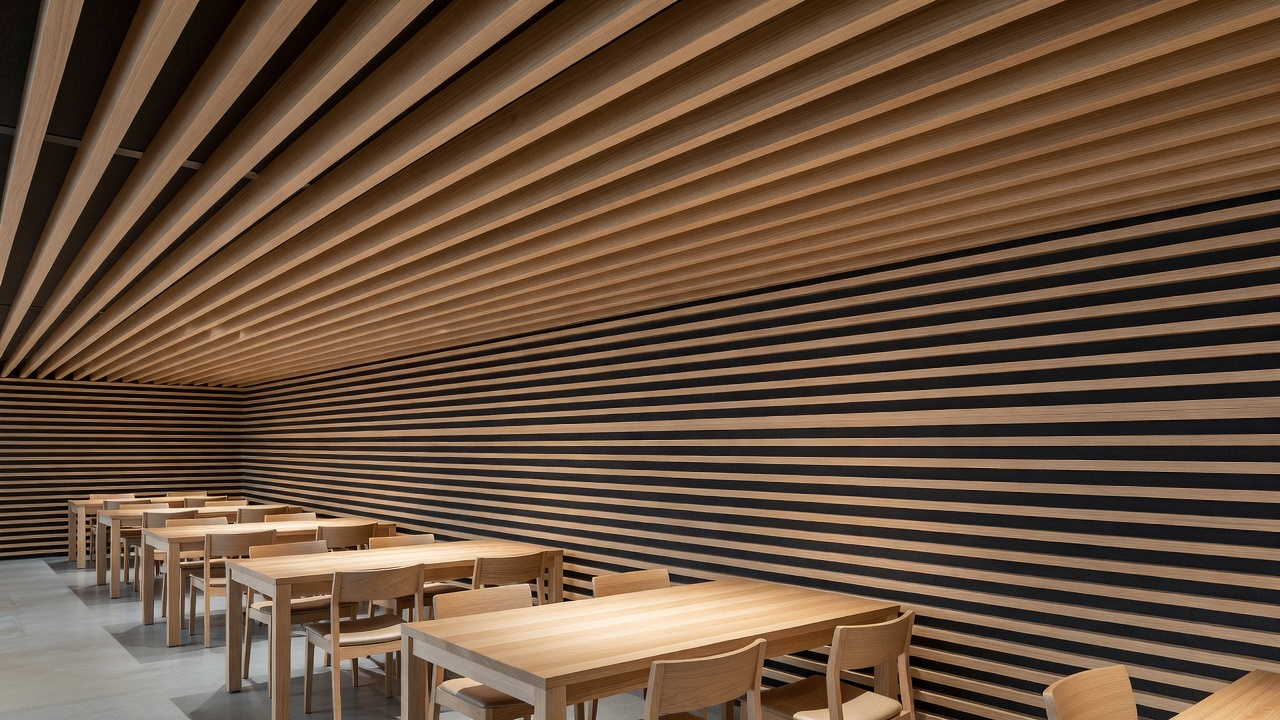
Great dining rooms do not erase sound; they sculpt it. Compare two renowned models: Keith McNally's Balthazar in New York embraces energetic brasserie chatter—tight banquettes, tall mirrors, and brass railings intentionally allow a brisk 0.85-second decay that makes solo diners feel folded into the crowd. By contrast, Copenhagen's Noma (designed with Studio David Thulstrup) and Snøhetta's coastal restaurant Under in Lindesnes deploy extensive timber-slat acoustic ceilings and textile wraps so speech stays intimate even when rooms are fully booked.
A subtle mistake occurs when designers place absorption only on the ceiling while leaving walls entirely bare. Sound waves travelling horizontally from table to table still bounce cleanly between parallel walls at ear height (1.1 to 1.4 meters above the floor). Breaking up that band with upholstered banquette backs, cork wall tiles, bookshelves, or framed wool tapestries stops cross-talk at its exact plane of travel.
Finally, never overlook mechanical noise. Before adding a single decorative felt panel, measure the empty room with HVAC, wine chillers, and kitchen exhaust running at full dinner load. If background equipment already hums at 54 dBA, guests begin their evening fighting a noise floor they cannot even identify. Quiet duct velocity (below 3.5 m/s at diffusers) and anti-vibration mounts under refrigeration compressors buy more conversational ease per euro than almost any finish upgrade.